Rwanda · nature
Walking Nyungwe National Park from Uwinka or Gisakura
In Nyungwe, the key decision is not to pack in activities: it is to choose a base, gauge the effort involved and leave room for a changing mountain forest.
Conditions described in the guide: confirm current requirements and access with the official source before travelling.

Nyungwe National Park calls for a different kind of trip from a scenic sightseeing visit: its highlights are discovered on foot, with a guide and in weather that can change quickly. The most useful expectation is to walk in order to interpret the forest and understand that primate tracking depends on free-ranging animals, not on a fixed viewing schedule. Choosing carefully between Uwinka and Gisakura, and booking only the activities that fit your fitness level and timetable, makes the visit calmer and also more respectful of this protected afromontane forest.
Choose your base before planning the day
Nyungwe lies in southwestern Rwanda and does not work well as a rushed day trip from Kigali: reaching it by road requires a long transfer day. The practical approach is to spend at least one night near the park and arrange activities from one of its two main reception areas.
Uwinka suits travellers who prioritise trails and the elevated walkway: ten routes begin there, and the approach to the Canopy Walkway is part of the experience. Gisakura is better suited to those interested in combining forest paths with community experiences and the tea plantations nearby; three trails begin from this sector.
The difference matters because Nyungwe is not a compact site. It is a mountainous expanse of forest, bamboo, peat bogs and high-altitude grasslands, inscribed as a natural World Heritage Site in 2023. Check the trail map and departure time before confirming your accommodation: changing bases on the same day can take many hours away from your actual walking time.
Choose one main experience, not three versions of the same thing
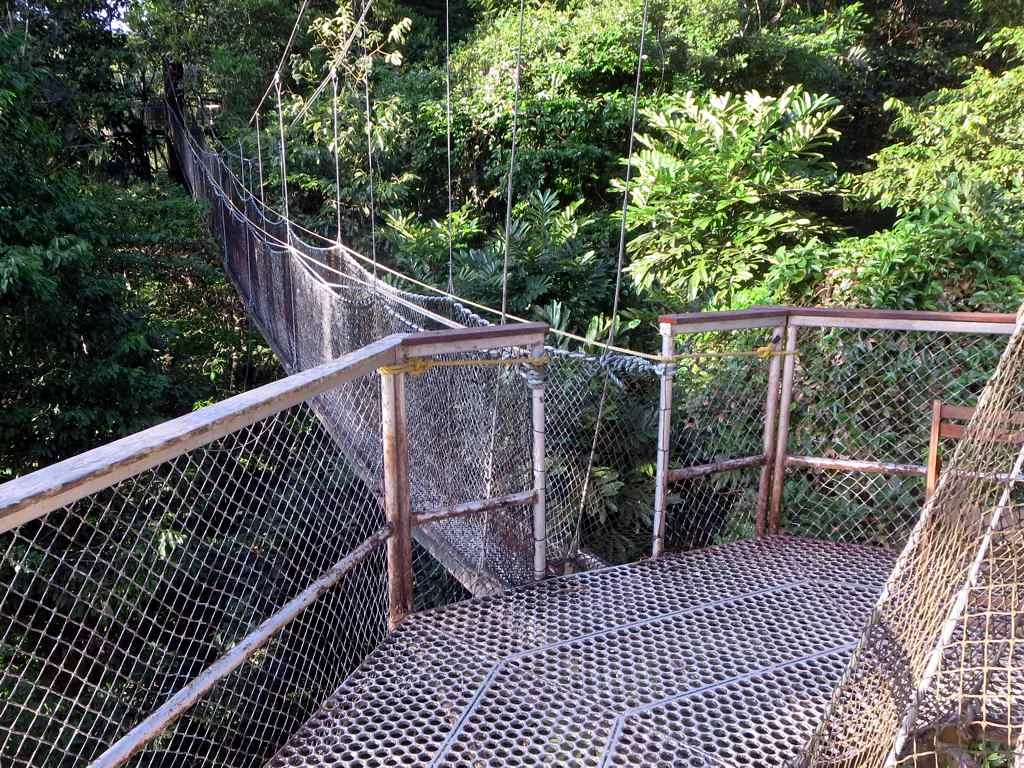
The Canopy Walkway is the most direct way to understand the forest’s vertical scale. The suspended walkway is 160 metres long and rises about 70 metres above the ravine; it is reached by a hike from Uwinka. It can fit into an arrival day if you have slept nearby, but it should not be treated as an effortless stop: the approaches are steep and the ground may be muddy.
Chimpanzee tracking follows a different rhythm. Visitors enter one of the semi-habituated communities in a limited group with a guide; the route and viewing time depend on where the animals are that morning. It is the best choice for anyone prepared for an early start, variable terrain and an experience centred on tracking rather than getting a quick photograph.
If you want a more predictable day, prioritise a guided trail. The short Igishigishigi trail provides access to the walkway; Uwinka is considered demanding because of its ravines; and Imbaraga, almost 10 kilometres long, is intended for experienced hikers and links several waterfalls. Choose one wildlife activity or one long route as the focus of the day and leave everything else as breathing room, not an obligation.
Take rain, elevation gain and altitude seriously
In Nyungwe, basic equipment changes the experience. Bring grippy footwear, a light waterproof layer, water and protection for electronic devices. Rain can turn well-maintained paths into slippery surfaces, especially on the slopes; the walkway and trails are not a good choice for anyone who is uncomfortable with heights or uneven ground.
The park operates activities year-round, but afternoons are more likely to be wet. It is therefore usually sensible to schedule the walks that matter most to you in the morning and keep the afternoon free of tight transport connections. Do not confuse year-round availability with identical conditions: the precise state of the trails, departure times and activities on offer should be confirmed before you travel.
There is not enough documented basis to promise a fully accessible visit. If you travel with reduced mobility, vertigo, a recent injury or specific needs, ask the park reception directly which activity might be adapted to your situation and what support is available on the day.
Make your booking reflect the place you are visiting
The park’s walks are led by independent community guides trained in nature interpretation. Following their instructions—including distances from primates, the group’s pace and areas where you must not leave the trail—is an essential part of the visit, not an administrative formality.
If you have an extra afternoon, ask in Gisakura about activities offered by nearby communities, including tea tours, crafts, pottery, metalworking, dances and local practices. It is best to choose them because you genuinely want to understand a form of work and a place, rather than as an automatic add-on between two wildlife activities.
Book chimpanzee tracking and any outing with limited places in advance. Before paying, check current fees, permitted ages, maximum group size, weather conditions, meeting point and change policy. Rules and prices may be updated; it is also worth checking road conditions and transfers from Kigali or Kamembe with official operators.
References to check before booking
- Nyungwe National Park: activities, bookings, accommodation and 2025–2026 fees. Consult it for current availability, participation conditions, prices and schedules.
- Rwanda Tourism: information on the Canopy Walkway and hiking in Nyungwe. Consult it for route features, equipment recommendations and operational status.
- UNESCO World Heritage Centre: information and the inscription decision for Nyungwe National Park on the World Heritage List in 2023.
- African Parks: information on Nyungwe’s management, biodiversity and community development. Consult it for conservation context and the involvement of community guides.
Information reviewed on 11 September 2026. Operational details should be checked again immediately before departure.
References consulted during editorial review. Times, requirements and advisories may change: always confirm with the official source.
- https://www.africanparks.org/the-parks/nyungwe/park-revenue-generationwww.africanparks.org
- https://visitrwanda.com/interests/canopy-walkway/visitrwanda.com
- https://uat.visitrwandabookings.rdb.rw/rdbportal/tourist-permituat.visitrwandabookings.rdb.rw
- https://www.africanparks.org/the-parks/nyungwewww.africanparks.org
- https://www.africanparks.org/the-parks/nyungwe/nyungwe-biodiversity-conservationwww.africanparks.org
- https://www.africanparks.org/sites/default/files/uploads/resources/2025-06/2024-African_Parks_Annual_Report.pdfwww.africanparks.org
- https://www.africanparks.org/sites/default/files/uploads/resources/2024-05/0194-AP_2023_Annual_Report-Web_Ready.pdfwww.africanparks.org
- https://visitrwanda.com/wp-content/uploads/2024/03/Visit-Rwanda-Priced-Packages.pdfvisitrwanda.com
- RuandaWikidata · CC0 1.0 · Wikidata · Q1037
- RuandaWikidata · CC0 1.0 · Wikidata · Q7375711
- RuandaWikidata · CC0 1.0 · Wikidata · Q7375712
- RuandaWikidata · CC0 1.0 · Wikidata · Q35283154
- RwandaWorld Countries — mledoze · ODbL 1.0 · World countries dataset by mledoze and contributors · ODbL 1.0
- RwandaWorld Bank Open Data · CC BY 4.0 · World Bank
- RwandaDBpedia · CC BY-SA 3.0 · DBpedia