Cyprus · Troodos
Three Painted Churches to Explore in the Solea Valley
A focused itinerary through Kakopetria, Galata and Nikitari for understanding Troodos’s frescoes without trying to cover all ten World Heritage churches.
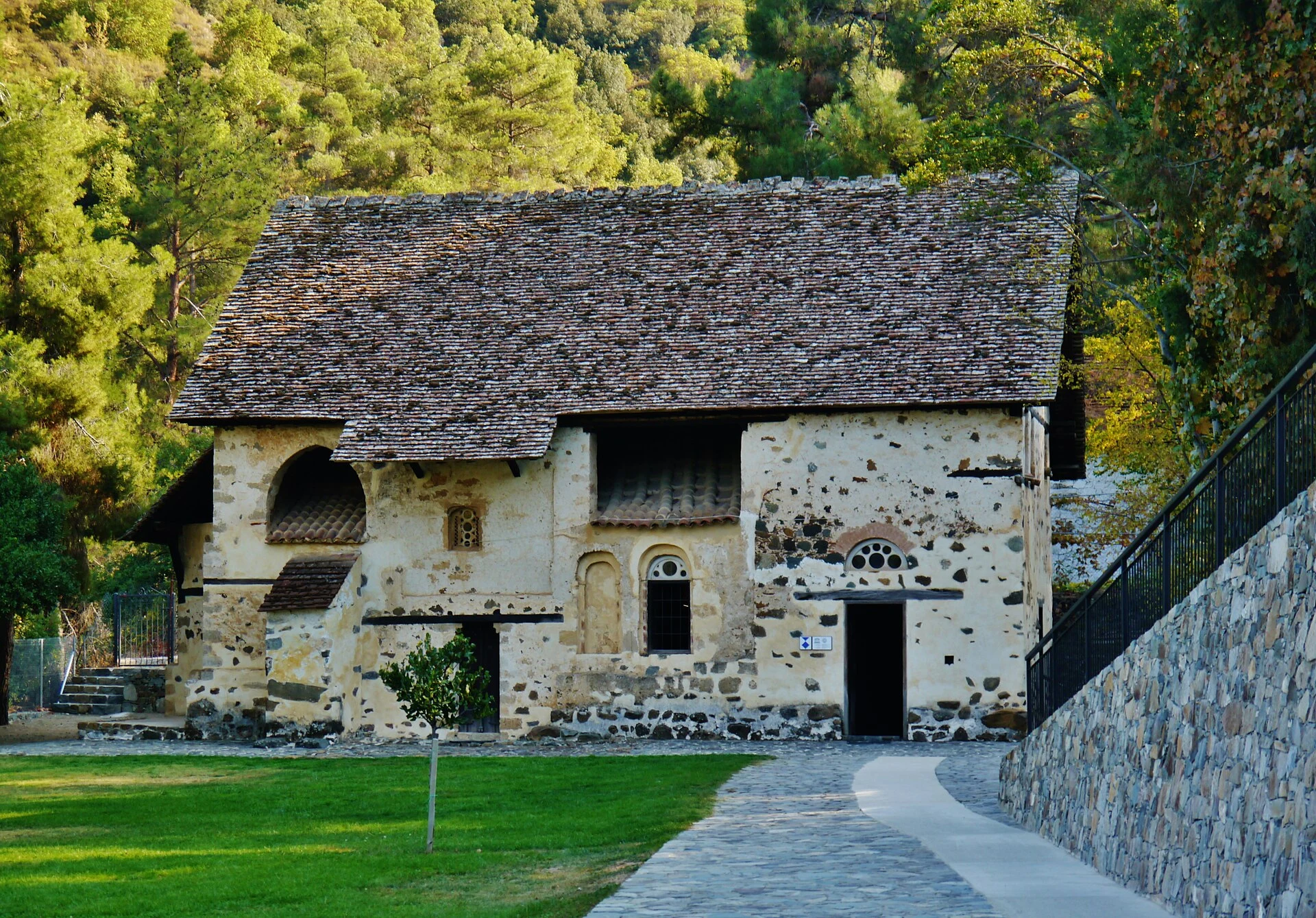
The painted churches of Troodos do not form a single site: they are ten monuments scattered across mountain villages and valleys. For a first day, the Solea Valley makes it possible to focus on three very different works—Agios Nikolaos tis Stegis, Panagia Podithou and Panagia tis Asinou—and to make the journey between them part of reading the landscape. The reward lies not in counting temples, but in comparing how rural architecture with timber roofs protects centuries of wall painting.
A short route with three clear contrasts
The most practical order is to start at Agios Nikolaos tis Stegis, near Kakopetria; continue to Panagia Podithou, on the outskirts of Galata; and leave Panagia tis Asinou, near Nikitari, until last. This is a route designed for a private vehicle or a pre-booked taxi: the monuments are scattered, and opening hours can split the day in two.
Do not try to add all ten listed churches in a single day. The official route distributes them across Solea, Marathasa and Pitsilia, three different mountain areas. Limiting yourself to this triangle leaves time to enter without rushing, wait if a religious service or conservation work is under way, and stroll through old Kakopetria instead of turning it into a hurried stop.
Before setting out, check the official listings for access to each church, closing days, current opening hours and the relevant contact person. These are places of worship, and availability can change without notice.
Agios Nikolaos tis Stegis: reading the church as a palimpsest
Agios Nikolaos tis Stegis was the main church of an 11th-century Byzantine monastery and is the only surviving monastic katholikon from that period on the island. Its silhouette explains the name tis Stegis, “of the roof”: a tall, steep outer roof shelters the vaulted structure and the narthex.
Inside, the interest lies in the accumulation of layers. The paintings span the 11th to the 17th century, so it is not a place to look for a single stylistic unity. Begin with the dome and the evangelists; then turn to the scenes and figures in the nave and narthex. It is an excellent introduction to Troodos’s central idea: small-scale churches preserving exceptionally dense pictorial programmes.
The stop works well as a starting point because it lies away from Kakopetria’s centre. Allow time for the transfer and do not assume that you can walk there from the village. If you want to combine heritage and downtime, save a stroll through Kakopetria’s historic lanes for after the visit rather than treating it as a substitute.
Panagia Podithou: painting that blends different visual languages
Panagia Podithou, north of Galata, offers a deliberate contrast. It was the church of a monastery and was built in 1502; its single nave, portico and broad timber roof create an architectural setting very different from Agios Nikolaos tis Stegis’s vaulted plan.
The interior is not entirely covered with frescoes. That distinction matters: the visit focuses on the painted areas, the foundation inscription and the iconostasis. The paintings are a reference point for the Italo-Byzantine style, in which Orthodox repertoires engage with elements associated with the Italian Renaissance during the Venetian period. The donor figure presenting a model of the church to the Virgin helps read the building as a work connected to patronage, devotion and local power.
The official tourist listing indicates adapted-access features, but the actual accessibility of a journey also depends on parking, changes in level, available toilets and whether the church is effectively open. Visitors with reduced mobility should confirm these details directly before travelling.
Panagia tis Asinou: a final stop for reading several periods
Panagia tis Asinou stands beside a stream, a few kilometres from Nikitari, on the site of a former monastery of which the church is the principal surviving remnant. The nave and narthex contain paintings from several phases, dating from the 12th to the 17th century. Rather than treating it as a quick final stop, use it to compare the changes seen during the day: Agios Nikolaos tis Stegis’s broad chronology, Podithou’s Italo-Byzantine synthesis and Asinou’s different layers.
Its relative isolation is part of the experience, but it also sets a practical limit. Carry water, download the map before leaving the main roads and avoid planning to arrive at the very end of opening hours. If the interior is not accessible when you arrive, do not force the visit or turn the religious site into a place for hurried photographs: adjust the itinerary and allow more time for Kakopetria or Galata.
The value of these churches depends on their remaining living monuments and on the preservation of fragile wall paintings. Speak quietly, follow the photography instructions and do not use flash even if no sign is visible. The most responsible visit is also the one that leaves room for worship and conservation to take priority.
What to check on the day
Opening times, public holidays, custodians’ contact details, photography conditions, conservation work and any accessibility adjustments are all subject to change. Review the official listings for each monument before driving towards Solea. If you can secure only two visits, prioritise Agios Nikolaos tis Stegis and Panagia tis Asinou for a broad chronological overview; add Podithou if you are especially interested in the meeting of Byzantine and Italian traditions.
### References to check before setting out
- UNESCO World Heritage Centre, Painted Churches in the Troodos Region.
- Department of Antiquities of Cyprus, monument listings for Agios Nikolaos tis Stegis, Panagia Podithou and Panagia tou Arakou.
- Deputy Ministry of Tourism of Cyprus, Byzantine Route: 10 Painted Churches of Troodos Religious Route and listings for Agios Nikolaos tis Stegis, Panagia Podithou and Panagia tis Asinou.
- Cyprus National Commission for UNESCO, information on the painted churches of Troodos.
References consulted during editorial review. Times, requirements and advisories may change: always confirm with the official source.
- https://whc.unesco.org/en/list/351whc.unesco.org
- https://whc.unesco.org/en/list/351/gallery/whc.unesco.org
- https://whc.unesco.org/en/documents/143688whc.unesco.org
- https://whc.unesco.org/en/decisions/2314/whc.unesco.org
- https://whc.unesco.org/document/463whc.unesco.org
- https://whc.unesco.org/en/statesparties/cy/whc.unesco.org
- https://whc.unesco.org/en/list/351/whc.unesco.org
- https://whc.unesco.org/document/1280whc.unesco.org
- ChipreWikidata · CC0 1.0 · Wikidata · Q229
- ChipreWikidata · CC0 1.0 · Wikidata · Q5200433
- ChipreWikidata · CC0 1.0 · Wikidata · Q2967757
- ChipreWikidata · CC0 1.0 · Wikidata · Q23725942
- CyprusWorld Countries — mledoze · ODbL 1.0 · World countries dataset by mledoze and contributors · ODbL 1.0
- CyprusWorld Bank Open Data · CC BY 4.0 · World Bank
- Niebla de ChipreCrossref · Metadatos públicos; derechos específicos por campo cuando correspondan · Crossref