Peru · Supe Valley
Caral-Supe and Its Sunken Plazas: Understanding an Ancient City
Caral-Supe is best experienced as a city conceived in relation to the river, the desert and its ceremonial spaces—not as a succession of pyramids.
Conditions described in the guide: confirm current requirements and access with the official source before travelling.
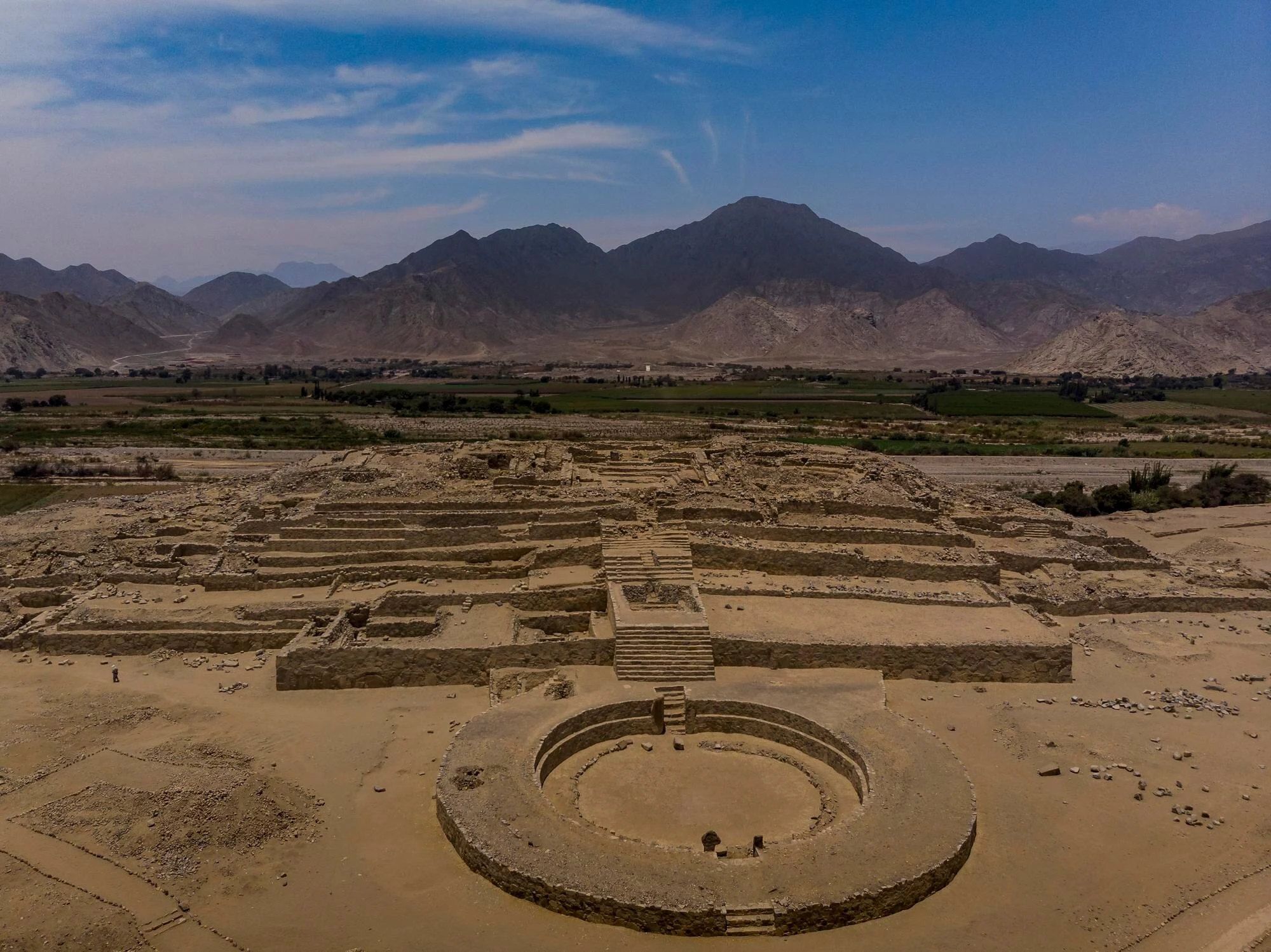
A few hours by road north of Lima, Caral-Supe offers a visit on a different scale: less about isolated objects and more about spatial relationships. Monumental platforms, residential complexes and sunken circular plazas form a city whose logic becomes clear when you walk slowly and pay attention to changes in elevation, entrances and views towards the Supe Valley. It is a rewarding destination for anyone wanting to spend a day exploring Andean archaeology without turning the experience into a race to take photographs.
Arrive with a clear idea of what you are going to see
Caral does not function like a museum of artefacts or a compact ruin. It is an extensive settlement built on an arid terrace above the valley, and its interest lies in the composition of the whole. Its chronology belongs to the Initial Formative period, between 3000 and 1800 BC; it is therefore best not to look for Inca references or imagine the city according to later models.
The first useful decision is to set aside time for the interpreted tour. Understanding the structures—platforms, enclosures, residential areas and sunken plazas—adds considerably to the experience, because you can see the visual and ritual connections proposed by each space. This is not a brief stop on the way to somewhere else: allow for the journey there and back, the approach to the site and an unhurried visit.
The sunken plazas provide the key to the route
The large platforms attract attention from a distance, but the sunken circular plazas explain Caral’s spatial experience more clearly. Descending into a plaza changes your relationship with the landscape: the horizon partly disappears, the walls frame the space and the stairways organise access. Then, as you climb again, the valley and desert come back into view.
This contrast helps you read Caral as a city of routes and collective gatherings, not simply as a group of monumental structures. Also look at how the public-use areas are separated from the residential sectors. The circuit does not require you to answer every archaeological question; it does allow you to distinguish between looking at a structure for its volume and understanding it through its position within the city.
The valley matters as much as the buildings
The city stands on a desert terrace but faces a fertile valley crossed by the Supe River. This proximity is essential to interpreting the site: the landscape is not a backdrop, but part of the decisions concerning settlement, supplies and the organisation of the territory.
Bring sun protection, water and sturdy footwear for earthen ground. The usual approach from the visitor centre includes crossing a pedestrian bridge and following a marked stretch through a huarango grove; this entrance makes visible the transition between the living valley and the archaeological terrace. Do not cross the riverbed on your own initiative: access by that route depends on the season and on the administration’s current instructions.
A visit that can work for people with mobility needs
The site reports an accessible path, inclusive toilets and the loan of adapted wheelchairs requested at the ticket office. Even so, accessible infrastructure does not remove all the variables involved in a day trip outside Lima: the road journey, the chosen transport, the heat and the distance from the car park may all affect the experience.
If you travel with reduced mobility, contact the administration in advance to confirm the condition of the path, wheelchair availability, the most convenient drop-off point and any assistance your group may need. This check is particularly important before weekends, public holidays or periods when the river flow is higher.
One day, or a wider archaeological valley
Caral is enough for a day trip from Lima if your aim is to understand the city properly. Adding other sites on the Caral Route on the same day only makes sense if you are prepared for a faster pace and additional transfers. Áspero, in the coastal area of Supe, can broaden the discussion to include the relationship between settlements, fishing and exchange; but it does not replace the observation time Caral demands.
For a first visit, the most coherent option is to concentrate on the Sacred City, listen to the interpretation, pause in a sunken plaza and look towards the valley several times. If the site raises more questions than answers, that is precisely a good reason to return or spend another day visiting the route’s other archaeological centres.
Before you leave: details to verify
The administration states that entry includes a guided interpretation. Before travelling, check the current opening hours, admission fee, interpretation availability, the active access route from the North Pan-American Highway and any notices concerning the flow of the Supe River. Also confirm the specific conditions of the accessible path and wheelchair loan if you need them.
References for checking before your trip
- Caral Archaeological Zone, Sacred City of Caral information sheet: access, circuit, services and accessibility conditions.
- Caral Archaeological Zone, opening hours and fees section: admission, interpretation options and operational changes.
- Peruvian Government platform, statements from Executive Unit 003 Caral Archaeological Zone: access notices connected with the Supe River.
- UNESCO World Heritage Centre, inscription of the Sacred City of Caral-Supe: archaeological context and the site’s values.
- Archaeology Bulletin of the Pontifical Catholic University of Peru, study on the Caral civilisation and its territorial management.
References consulted during editorial review. Times, requirements and advisories may change: always confirm with the official source.
- https://zonacaral.gob.pe/es/ruta-caral/horarios-y-tarifas/zonacaral.gob.pe
- https://zonacaral.gob.pe/es/noticias/comunicado-13/zonacaral.gob.pe
- https://zonacaral.gob.pe/es/ruta-caral/ciudad-sagrada-de-caral/zonacaral.gob.pe
- https://www.zonacaral.gob.pe/ruta-caral/ciudad-sagrada-de-caral.htmlwww.zonacaral.gob.pe
- https://zonacaral.gob.pe/es/noticias/como-llegar-a-la-ciudad-sagrada-de-caral-sin-fallar-en-el-intento/zonacaral.gob.pe
- https://www.zonacaral.gob.pe/downloads/publicaciones/libro-caral-supe-la-civilizacion-2008.pdfwww.zonacaral.gob.pe
- https://www.gob.pe/institucion/caral/noticias/899058-ingresa-gratis-a-la-ciudad-sagrada-de-caral-aspero-y-vichamawww.gob.pe
- https://zonacaral.gob.pe/es/noticias/nuevo-logro-la-ciudad-sagrada-de-caral-obtiene-el-distintivo-de-accesibilidad-turistica-tur4all/zonacaral.gob.pe
- PerúWikidata · CC0 1.0 · Wikidata · Q419
- PeruWikidata · CC0 1.0 · Wikidata · Q14083868
- PerúWikidata · CC0 1.0 · Wikidata · Q3352537
- PeruDBpedia · CC BY-SA 3.0 · DBpedia