Denmark · Wadden Sea
When to Cross to Mandø and Which Transport to Choose
On Mandø, southwest of Ribe, the point is not simply to reach “an island”: it is to accept that the tide determines access, pace and, sometimes, whether it makes sense to go at all. This guide helps you choose a visit that puts the living landscape—marshes, birds and dykes—ahead of a checklist of sightings.
Conditions described in the guide: confirm current requirements and access with the official source before travelling.
Mandø is a marsh island in Denmark’s Wadden Sea National Park, within the cross-border landscape inscribed by UNESCO. It has no permanent connection to the mainland, and a day there cannot be organised around rigid timetables: high tide covers the access routes and turns a short distance from the mainland into a logistical and environmental decision.
The useful question is not “How do I get there quickly?” but “What kind of visit can I make without putting pressure on the place?” For some people, the tractor bus is the most sensible way to cross; for others, staying on the mainland and taking an interpretive walk through the Wadden Sea will be the better plan. Mandø works especially well as a place to understand the relationship between marshland, dykes, birds and everyday life—not as a race to Koresand or a photo opportunity with seals.
First, decide whether Mandø fits your day
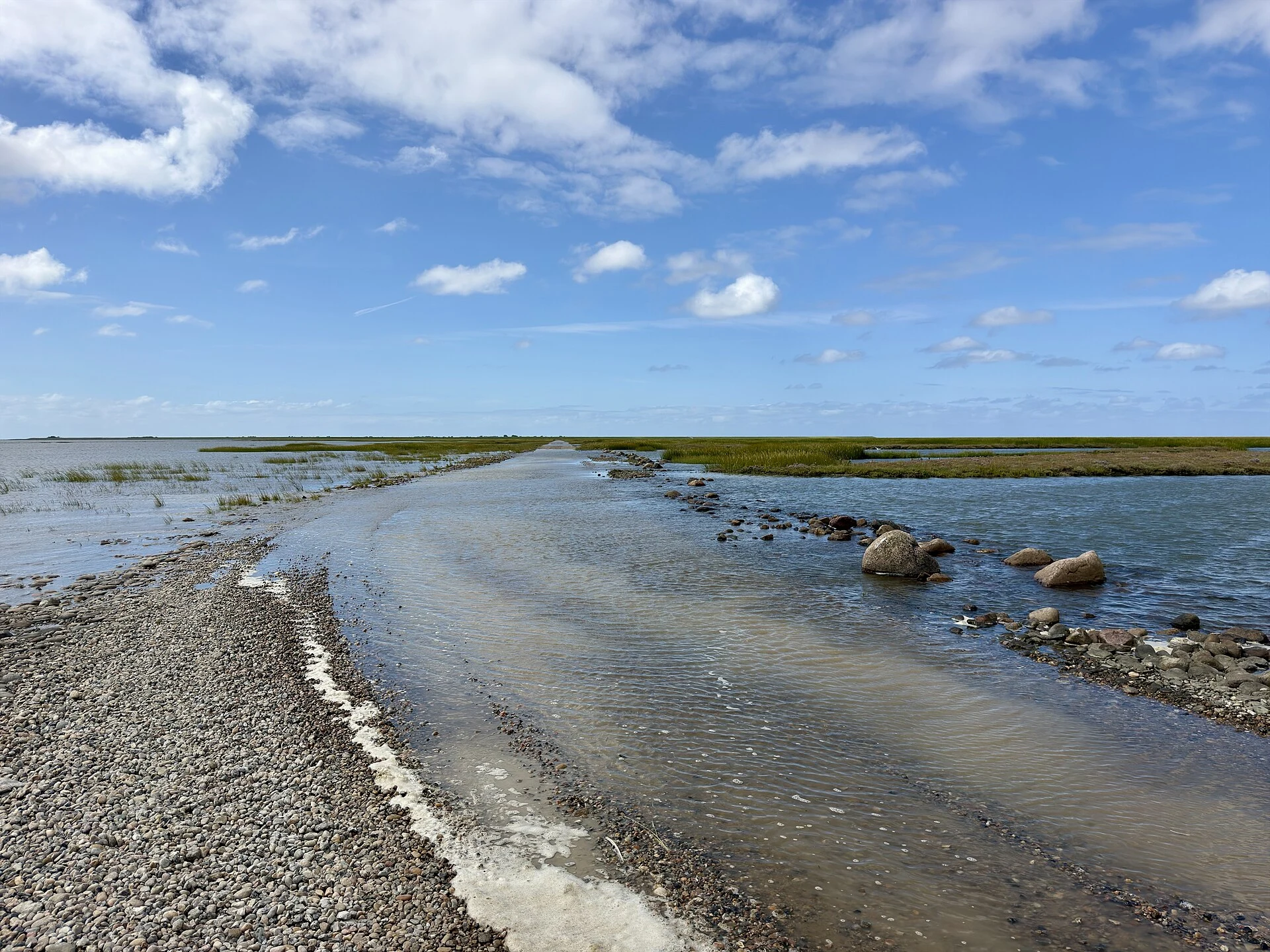
Mandø is a good choice if you can leave plenty of time before and after the crossing, enjoy walking slowly through a very flat landscape and accept that departure times depend on the tide. The island is connected to the mainland by Låningsvejen, a gravel causeway that floods, and by Ebbevejen, an old route across the seabed. The national park stresses that all travel takes place at your own risk and requires checking the tide table and current conditions.
It is not the best choice for a short stopover between Copenhagen and another city, for anyone who needs a fixed return time, or for those whose only aim is to see wildlife up close. The responsible alternative is not to “miss out” on Mandø: spend the time at the Wadden Sea Centre in Vester Vedsted and observe the landscape from mainland access points. The centre is also one of the starting points recommended by the national park.
Three ways to cross—and the commitment each one involves
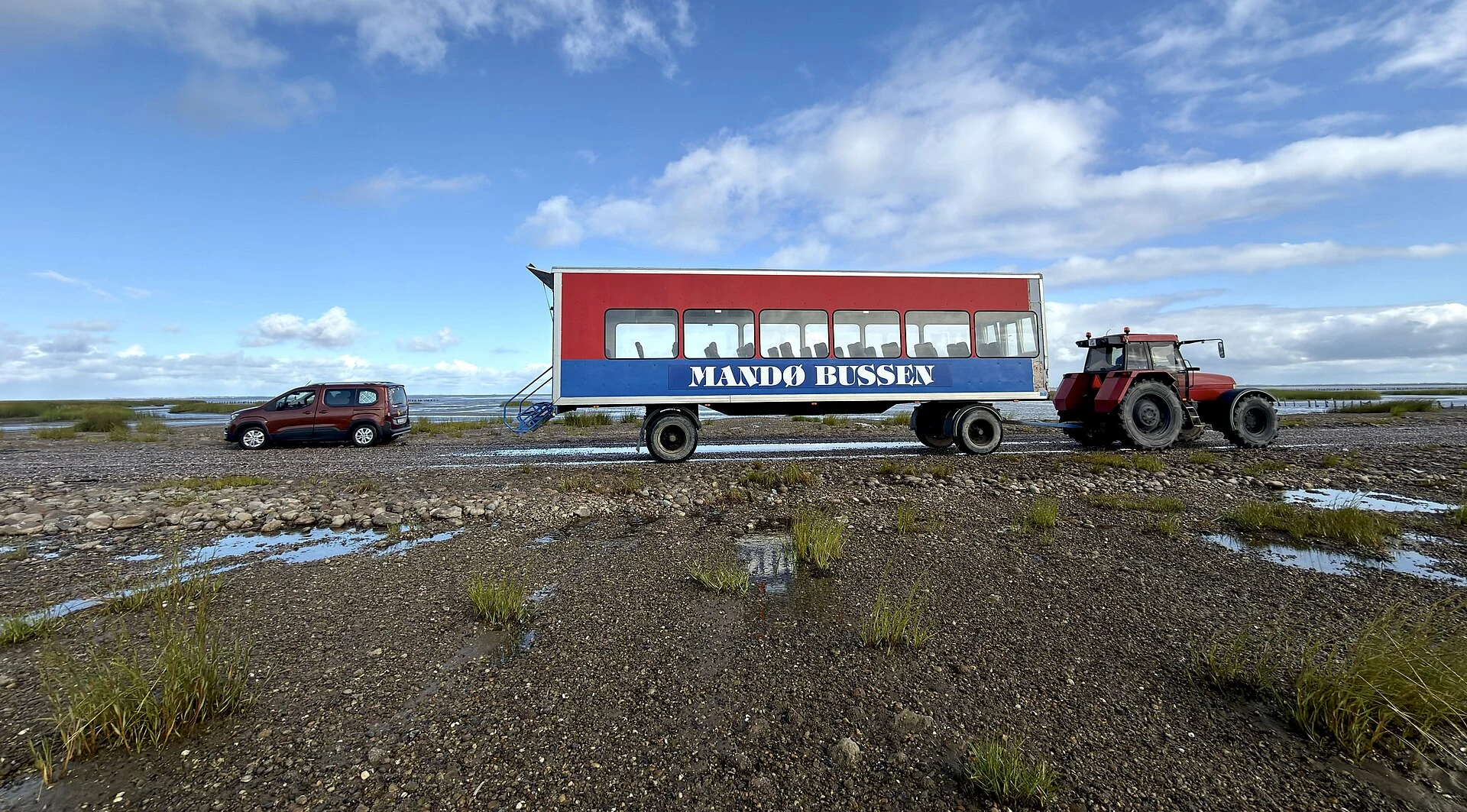
1. Tractor bus: the simplest option for a first visit. During the summer months, vehicles cross the tidal flats; departures vary from day to day according to the tide, and the journey from Vester Vedsted takes approximately 40 minutes. This is the sensible choice if you do not know the area, are not travelling by car or want the crossing itself to be part of reading the landscape. Check before booking the timetable, departure point, season and accessibility arrangements directly with the operator.
2. Driving along Låningsvejen: more independence, much more responsibility. The causeway is passable only when the tide, water level and local conditions allow it. Do not turn a general forecast into a guarantee: check the current report before setting out and do not improvise a late departure. Once on Mandø, the local tourism information says that parking is in the village and that driving vehicles around the island is not permitted.
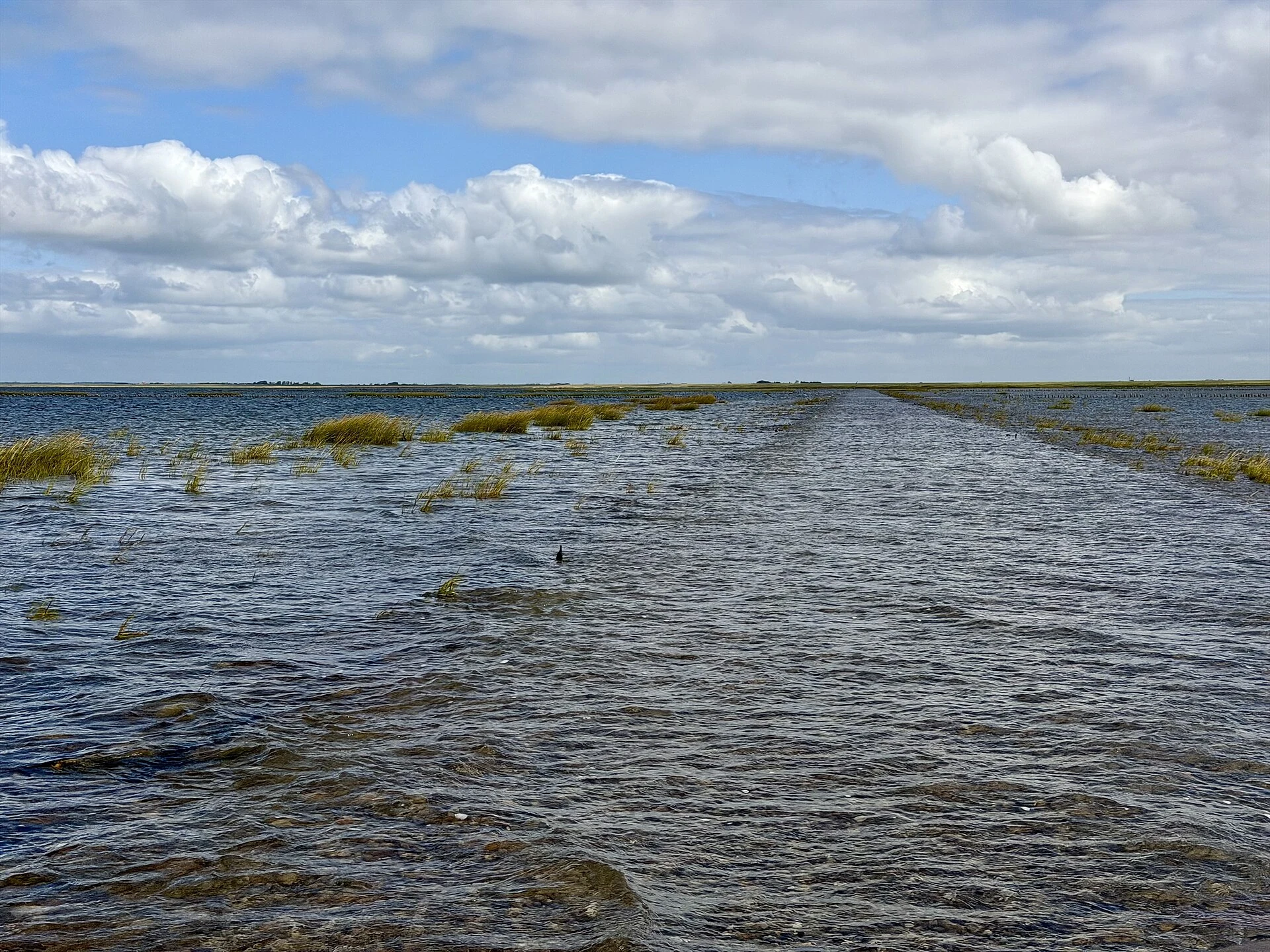
3. Walking along Ebbevejen: do not treat it as a shortcut. Private cars are not allowed on Ebbevejen. Although it can be understood as a marshland experience, the local tourism authority warns that the water returns quickly and advises staying near the starting point, following the signs and avoiding tidal channels. If you do not know how to interpret the tide, wind and terrain, choose a guided activity or remain on the mainland edge.
Once there: read the island from the dyke, not through a list of “attractions”
Mandø is not best understood as a beach or a conventional seaside holiday island. It is a marsh island: unlike the neighbouring Fanø and Rømø, which are predominantly sandy, it was formed by fine sediments deposited by the Wadden Sea. The village lies beside a small belt of dunes, while the rest of the territory speaks of protection from water, grazing land and open horizons.
A meaningful visit might involve walking through the village, recognising the column commemorating a historic flood, observing from authorised paths and calmly following the inland route beside the dyke. There is no need to pursue every point on the map. The value lies in noticing how the ground, light and presence of water change, and in understanding that the dyke is not a photographic backdrop but infrastructure for living alongside an exposed coast.
Koresand and the seals: decide whether watching from a distance is enough
Koresand, the large sandbank to the southwest, can be a powerful experience because of the contrast between high sand, marshland and open sea. The national park notes that guided tractor-bus excursions run there and that the area is shared by seals and seabirds.
That does not mean you have to go. If your main motivation is getting close to seals, it is worth reframing the plan: observation should not disturb their resting areas or displace birds. Keep your distance, stay on authorised paths or routes and do not turn wildlife into a target to approach. The official recommendation for Ebbevejen is explicit: respect wildlife and avoid approaching seals, flocks and marshes.
UNESCO protects the Wadden Sea precisely because it is a continuous system of intertidal flats, sandbanks, channels, seagrass meadows, marshes and habitats for migratory birds and marine mammals. Visiting Mandø carefully means allowing these processes to take priority over our itinerary.
When to go: choose a season for what you want to understand
Spring and autumn are the most interesting seasons if you want to observe the Wadden Sea’s migratory dimension: birds use this Atlantic corridor to rest and feed. They also call for especially careful behaviour: during the breeding season, local tourism authorities ask visitors to remain on roads and paths to reduce disturbance to nests and sensitive areas.
Summer generally makes logistics easier because this is when regular tractor-bus crossings are announced, but it does not guarantee a peaceful experience or remove the need to check tide-dependent timetables.
Winter can suit anyone looking for a spare, simple day, with less expectation of “doing everything” and more attention to weather and exposure. In every season, the decisive factor is not the month but the specific combination of tide, wind, visibility and available transport. Check these elements on the same day using official sources and with the operator you have chosen.
Accessibility, services and honest planning
The island is very flat, but that does not automatically make it accessible: there is gravel, exposed terrain, wind, routes governed by the tide and specialised transport. Local information indicates adapted public toilets near Klithus Mandø, but boarding, mobility, assistance and luggage requirements should be confirmed in advance with the tractor-bus operator and with your accommodation, if applicable.
Bring windproof and waterproof layers, footwear suitable for wet ground and water, and do not rely on finding services open at a particular time. Nor should you plan the visit as a driving route: park on arrival and continue on foot or by bicycle where permitted. If you are travelling with a dog, check the current rules and keep it under control; local information requires dogs to be leashed outside the home.
The best preparation is deliberately modest: allow a generous buffer, set an alternative in Vester Vedsted or Ribe, and consider cancelling or changing plans a normal part of the journey. On Mandø, adapting to the tide is not a compromise: it is the way to visit the place on its own terms.
References consulted during editorial review. Times, requirements and advisories may change: always confirm with the official source.
- https://www.visitdenmark.com/denmark/plan-your-trip/mando-ebbevej-gdk1158906www.visitdenmark.com
- https://www.visitdenmark.com/denmark/plan-your-trip/mando-island-our-nature-gdk1103164www.visitdenmark.com
- https://www.visitdenmark.com/denmark/plan-your-trip/mando-a-pearl-in-the-wadden-sea-gdk1151409www.visitdenmark.com
- https://www.visitdenmark.com/denmark/plan-your-trip/travelling-to-mando-gdk1077057www.visitdenmark.com
- https://www.visitdenmark.com/denmark/plan-your-trip/mando-on-your-own-gdk1111895www.visitdenmark.com
- https://www.visitdenmark.com/denmark/plan-your-trip/photo-spot-mando-gdk1138691www.visitdenmark.com
- https://whc.unesco.org/en/list/1314/whc.unesco.org
- https://www.visitdenmark.com/denmark/plan-your-trip/worth-knowing-about-mando-gdk1111897www.visitdenmark.com
- DinamarcaWikidata · CC0 1.0 · Wikidata · Q35
- DinamarcaWikidata · CC0 1.0 · Wikidata · Q5257930
- DenmarkWorld Countries — mledoze · ODbL 1.0 · World countries dataset by mledoze and contributors · ODbL 1.0
- DenmarkWorld Bank Open Data · CC BY 4.0 · World Bank