Central Tunisia · living urban heritage
Kairouan on Foot: Mosques, Aghlabid Cisterns and Medina Workshops
A well-planned day in Kairouan brings together the Great Mosque, the Aghlabid Cisterns and the medina’s streets without mistaking a place of worship for a backdrop.
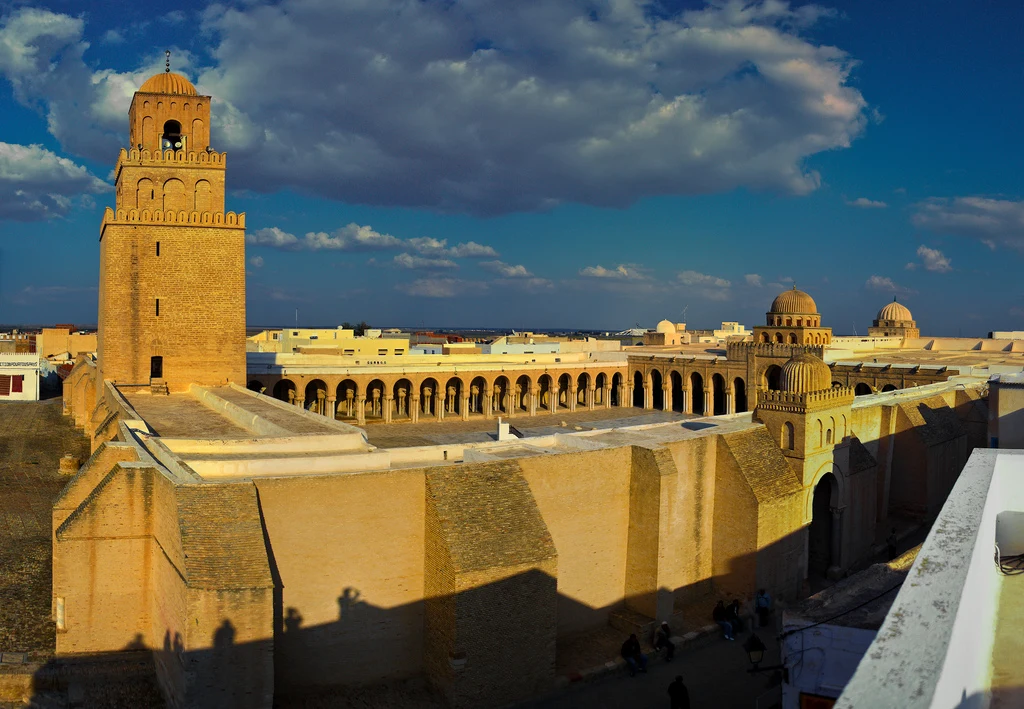
Kairouan is best understood as an inhabited city rather than a succession of monuments. Its medina, sanctuaries and former water reservoirs form a whole in which religious architecture and the historical management of water explain both the landscape and the rhythm of a visit. If you have one day, the useful decision is not to accumulate stops: reserve the morning for places whose access may vary and leave the afternoon for a slow walk through the urban fabric.
Start with the Great Mosque and shape the rest of the day around it
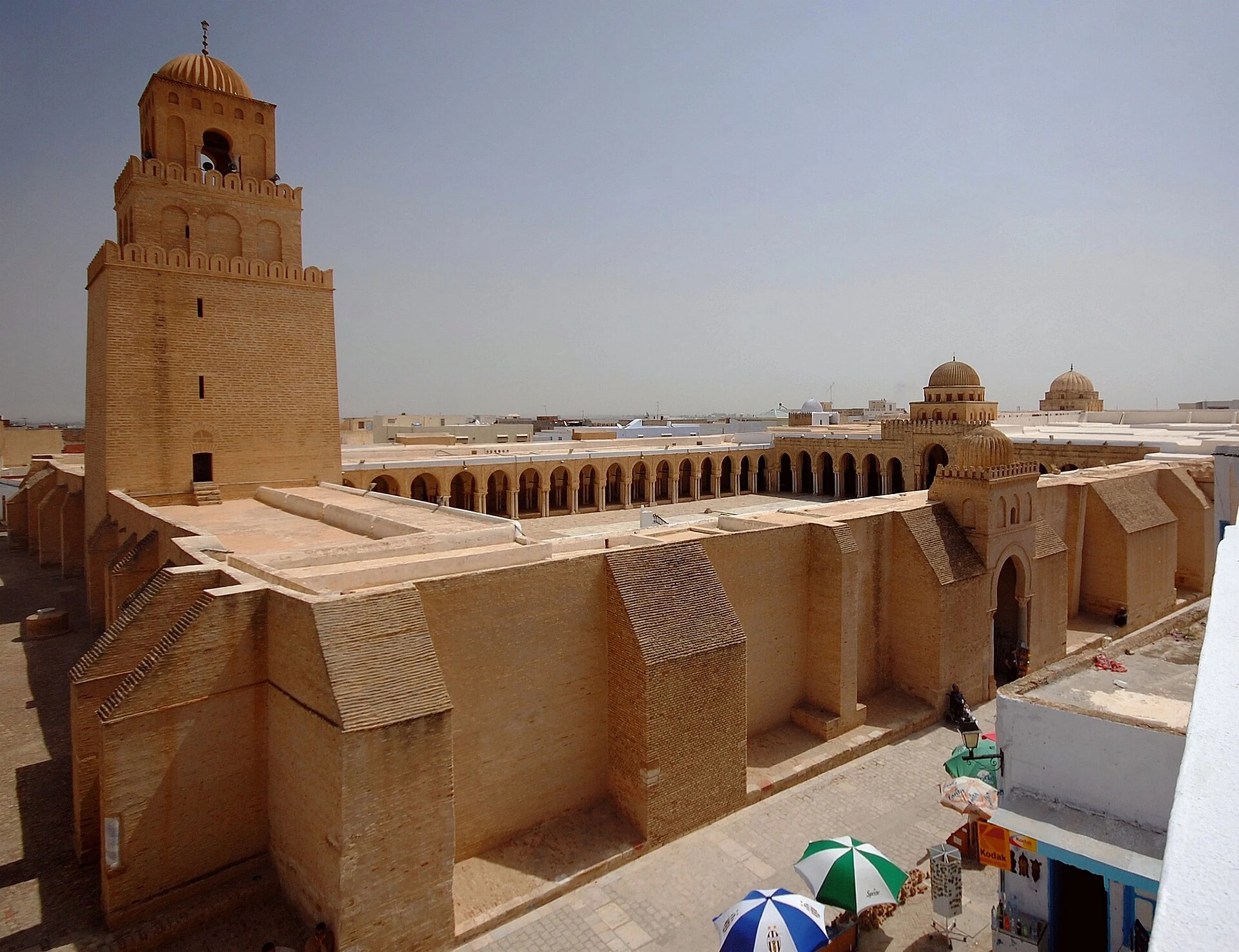
The Great Mosque of Uqba ibn Nafi is the best starting point because it gives Kairouan a sense of scale: the courtyard, minaret, hypostyle prayer hall and columns reveal why its design was so influential across the Maghreb. Do not treat it as a quick stop: take time to observe how the courtyard organizes the complex and how the prayer hall concentrates especially sensitive historic elements.
This is an active religious space, so visitor access may change according to prayer times, celebrations, works or staff instructions. Dress respectfully, keep your voice low and do not assume that every area will be open. If entry inside is not possible, the exterior, the courtyard when authorized and the immediate surroundings can still help you read the building without forcing an experience that is not appropriate for a visitor.
Then continue to the Mosque of the Three Doors. Its carved façade, dated to the ninth century, deserves a brief, attentive stop: here the interest lies in the façade and its inscription, not in lingering on a narrow street or interrupting the everyday life of the neighbourhood.
Read the Aghlabid Cisterns as infrastructure, not as a photographic backdrop
The Aghlabid Cisterns lie outside the medina’s most compact core and change your perspective on the city. They are two connected cisterns built in the ninth century to supply Kairouan: hydraulic works showing that an inland capital depended on complex technical systems to secure its water supply.
The comparison with the Great Mosque is revealing. There, orientation, the courtyard and congregation dominate; here, the open scale of the reservoirs speaks of storage, engineering and urban administration. Visiting both places on the same day prevents Kairouan from being reduced to an exclusively devotional image.
The cisterns’ surroundings have been associated with restoration and improvement work. Be prepared for perimeters, access points or views to have been altered by construction. Do not climb onto structures, cross barriers or describe every intervention as neglect: conserving a living heritage site involves technical decisions and visible changes.
The medina calls for orientation, pauses and a careful relationship with its workshops
Back within the walls, replace the logic of a rigid route with a short wander among winding streets, gateways and courtyard houses. The medina retains a residential fabric: walking unhurriedly helps you understand its proportions, but it does not turn every doorway into a visitor attraction. Respect privacy, ask permission before photographing people or interiors, and keep entrances to homes and shops clear.
Crafts are part of this urban economy. Tunisia’s Ministry of Tourism identifies an artisan village in the medina with workshops devoted, among other trades, to hand embroidery. If you enter a workshop, a brief conversation about process, materials and authorship is more worthwhile than aggressive bargaining. Buying only what you can carry and value, asking who made an item and avoiding objects that imitate antiquities are more useful gestures than chasing something “typically Tunisian”.
The walk has a practical limit: uneven paving, narrow passages and intermittent shade can make it uncomfortable for people with reduced mobility, pushchairs or anyone avoiding the heat. Plan breaks away from the narrowest corridors and consider a short taxi ride to connect the medina with the cisterns.
A realistic day: four stages and one transport decision
A balanced visit fits into one day if you accept that there will not be time to turn every building into a stop. Morning: Great Mosque and Mosque of the Three Doors, adapting the order to that day’s access conditions. Midday: a break outside the busiest periods of religious activity. Early afternoon: Aghlabid Cisterns. Afternoon: a short walk through the medina, its workshops and one final view from around the walls.
Kairouan is not among the main destinations on the national passenger rail network, so it is unwise to plan the day on the assumption of a direct train arrival. Decide on intercity transport before fixing your urban route, and allow time for connections or schedule changes. Once in the city, combining walks with an occasional taxi is usually more sensible than trying to link every point on foot under the sun.
Check opening times, accessible areas, clothing requirements, works and transport on the same day. These changeable details determine whether the day unfolds calmly or becomes a race.
Official references to check before you go
- UNESCO World Heritage Centre: description, boundaries and conservation status of Kairouan’s ensemble; useful for understanding the relationship between the medina, suburbs, Aghlabid Cisterns and the zawiya of Sidi Sahib.
- Kairouan Municipality: local information on the Great Mosque, Mosque of the Three Doors, Aghlabid Cisterns and other urban landmarks.
- Tunisian Ministry of Tourism: information about craft workshops located inside the medina.
- Kairouan Regional Directorate of Religious Affairs: institutional reference for confirming visitor access and conditions in places of worship.
- SNCFT, Tunisian National Railways: current rail network and schedules; essential to consult before planning connections.
References consulted during editorial review. Times, requirements and advisories may change: always confirm with the official source.
- https://whc.unesco.org/en/statesparties/tn/whc.unesco.org
- https://whc.unesco.org/en/list/499whc.unesco.org
- https://whc.unesco.org/en/statesparties/tn/documentswhc.unesco.org
- https://www.sncft.com.tn/en/passengers/presentation/www.sncft.com.tn
- https://whc.unesco.org/en/listwhc.unesco.org
- https://www.sncft.com.tn/en/the-sncft/overview/www.sncft.com.tn
- https://whc.unesco.org/document/104455whc.unesco.org
- https://www.sncft.com.tn/en/home/www.sncft.com.tn
- TúnezWikidata · CC0 1.0 · Wikidata · Q948
- TúnezWikidata · CC0 1.0 · Wikidata · Q3572
- TunisiaWorld Countries — mledoze · ODbL 1.0 · World countries dataset by mledoze and contributors · ODbL 1.0
- TunisiaWorld Bank Open Data · CC BY 4.0 · World Bank